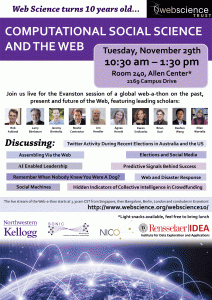
Please join us in celebrating the 10th birthday of Web Science at Northwestern University – the final stop of a 10-hour web-a-thon that will have spanned the globe from Singapore, Bangalore, Berlin, and London before landing in Evanston.
Advancing The Science of Networks in Communities
Please join us in celebrating the 10th birthday of Web Science at Northwestern University – the final stop of a 10-hour web-a-thon that will have spanned the globe from Singapore, Bangalore, Berlin, and London before landing in Evanston.
Nearly 20 percent of all election-related tweets come from an army of influential robots.
Read the full article here.
Congratulations to Alina, who received the Northwestern University School of Communication 2016 Graduate Dissertation award, granted annually by the department.
The title of her dissertation is “Assembly Mechanisms of Interdisciplinary Scientific Teams and Their Impact on Performance”.
SONIC Lab is proud to welcome Ingmar Weber who will present a talk on Wednesday, November 16th, 2016 at 10:00 AM in Frances Searle Building, Room 1-459. Please contact SONIC Lab Manager Katya Bitkin with any questions or comments.
Abstract
How do demographic attributes affect network structure and content spread? In this talk, I’ll present attempts to address this question using a demographically annotated data set for 350K Twitter users in New York. For each user, their gender, age and race has been inferred from their profile picture using Face++. I’ll start by showing that population-level differences in hashtag usage are intuitive, such as African Americans being more likely to use #blacklivesmatter, women more likely to use #makeup, and young people more likely to use #growingupwithsiblings. Taking ideas previously studied in the context of web search, we then look at which demographic groups are generally first – or last – to use new hashtags. Here we find that, e.g., new music-related hashtags tend to originate from African American users, whereas new baseball hashtags come from white men. Looking at the topic of “algorithmic bias”, we show that the “what’s trending” tends to favor the majority group, potentially creating hurdles for minority content to benefit from system-induced feedback. Finally, I’ll show results related to racial link asymmetries, potentially indicating latent discrimination.
The work presented is joint work with Jisun An at QCRI, and several members of the Social Dynamics Lab (http://sdl.soc.cornell.edu/) at Cornell University, including Michael Macy, George Berry, Minsu Park and Chris Cameron. The research varies in terms of doneness from “medium well” to “rare”. More information on past projects at http://ingmarweber.de/publications/.
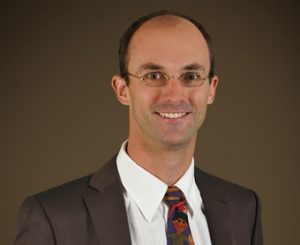
Ingmar Weber is a senior scientist in the Social Computing Group at the Qatar Computing Research Institute (QCRI) in Doha. He uses large amounts of online data to address research questions of societal relevance related to (i) lifestyle diseases, (ii) societal fragmentation, and (iii) international migration. He has published over 100 peer-reviewed articles (http://ingmarweber.de/publications/) and his work is frequently featured in the popular press (https://www.google.com/search?tbm=nws&q=%22ingmar+weber%22). Since April 2016 he’s been selected as an ACM Distinguished Speaker.
Complex networks form the backbone of modern society: the Internet, the aviation network, the pattern of connections between individuals. And more complex examples are constantly emerging—the way genes interact in cells, how information flows through the banking system and the ecosystem.
The more complex the system, the harder it is to control. 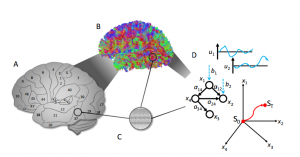 Nevertheless, computer scientists, doctors, economists and the like exercise a modicum of control over many of these networks.
And that raises an interesting question: is it possible to exercise the same kind of control over the most complex network we know of: the human brain?
SONIC is currently hosting the ATLAS team within its lab space.
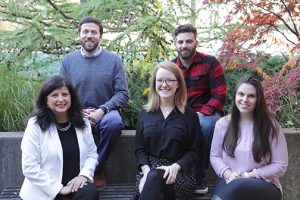 ATLAS (Advancing Teams, Leaders, and Systems) is the group formerly known as DELTA (Developing Effective Leaders, Teams, and Alliances) – expats from Georgia Tech, headed by their director Leslie DeChurch, who transferred to the Northwestern University this fall. Four students followed Leslie DeChurch: Lindsay Larson, Ashley Niler, Gabe Plummer, and Ilya Gokhman.
ATLAS are waiting for their lab space to be built out and equipped in time for the Winter Quarter. In the meantime, we are all enjoying the very close collaboration on our joint projects.
Despite what some politicians say, no country is an island in today’s rapidly changing world. In the same way, no company can survive as an island, either.
Most won’t have noticed a recent $6.5 million Series A for a company calledMobilize, but it’s indicative of a major change occurring in businesses today. Companies’ growing reliance on a distributed workforce have been occupying headlines and podcasts for the past couple of years. However, these conversations must now turn to how companies increasingly depend on partnerships as their force multiplier.
A Chicago company has marketed a tool using text, photos, and videos gleaned from major social media companies to aid law enforcement in surveillance of protesters, civil liberties activists say.
Click on the image below to read the whole article in The New York Times online.
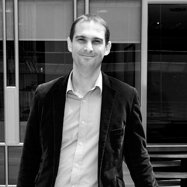
SONIC Lab is proud to welcome Eric Quintane who will present a talk on Monday, December 5th, 2016 at 10:00 AM in Frances Searle Building, Room 1-483. All are welcome to attend. To schedule a one-on-one meeting with Dr. Quintane please schedule a time HERE. Please contact SONIC Lab Manager Katya Bitkin with any questions or comments.
Abstract
Organizational network research has demonstrated that multiple benefits accrue to people occupying brokerage positions. However, the extant literature offers scant evidence of the process postulated to drive such benefits –information brokerage– and therefore leaves unaddressed the question of brokers broker. We address this gap by examining the information-brokerage interactions in which actors engage. We argue that the information-brokerage strategies of brokers differ in three critical ways from those of actors embedded in denser network positions. First, brokers more often broker information via short-term interactions with colleagues outside their network of long-term relationships, a process we label “unembedded brokerage.” Second, when they engage in unembedded brokerage, brokers are more likely than are actors in dense network positions to intermediate the flow of information between the brokered parties, consistent with a tertius gaudens strategy. Conversely, and third, when they broker information via their network of long-term ties (embedded brokerage), brokers are more likely than are densely connected actors to facilitate a direct information exchange between the brokered parties, consistent with a tertius iungens strategy. Using a relational event model, we find support for our arguments in an empirical analysis of email communications among employees in a medium-sized, knowledge-intensive organization, as well as in a replication study. The theory and evidence we present advance a novel, temporal perspective on how brokers broker, which reconciles structural and process views of network brokerage. Our findings substantiate the notion of brokers as a dynamic force driving change in organizational networks, and they help to integrate within a unitary explanatory framework tertius iungens and tertius gaudens views of brokerage.
Eric Quintane is an associate professor of management at the School of Management, The University of Los Andes, Bogota, Colombia. He received his Ph.D. from the University of Melbourne (Australia). His research interests include dynamics of organizational networks, temporality of social processes, creativity and innovation.
On the benefits of:
I was completely unplugged for the first time in months, and it felt really, really good…
(read the full article on thrillist.com)
and the complete pointlessness of it:
… the unplugging movement is the latest incarnation of an ageless effort to escape the everyday, to retreat from the hustle and bustle of life in search of its still core. Like Thoreau ignoring the locomotive that passed by his cabin at Walden Pond or the Anabaptists rejecting electricity, members of the unplugging movement scorn technology in the hope of finding the authenticity and the community that they think it obscures.