
What we’re reading – and how it ties us together
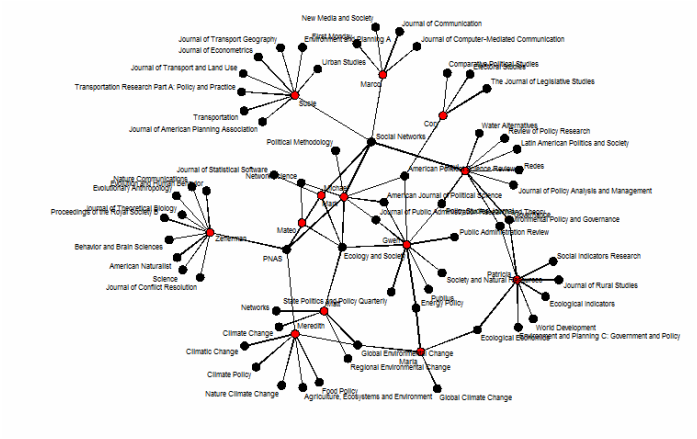
Michael Levy of the Center for Environmental Policy and Behavior at UC Davis created a bipartite network of using his coworkers and their preferred journals to illustrate the functional clusters within the highly interdisciplinary lab. He then converted the visualization into a single mode network using ggnet – a ggplot implementation (via the GGally package) and calculated degree, betweenness, and eigenvector centrality for each journal for a more detailed picture of the overlapping interests within his community. He provides his r code for anyone who wants to apply try the excersize with their own lab.
Check out Michael Levy’s blog to read more and play with his code : http://environmentalpolicy.ucdavis.edu/blog/2015/03/386
Les Misérables Co-occurrence
Given that an adjacency matrix is a natural representation of a network, a natural visualization is to show the matrix! Forget the tinker toys, who needs nodes and arcs? Amazing retro network visualization demonstrated using an old war horse sample network and d3.js from Mike Bostock. Check it!
Graphs Beyond the Hairball
By Robert Kosara On
Dual-representation, matrix/node-link diagrams and “node quilts.” Read more…
Wikipedia Breaking News Picked up by Forbes
The visualization we featured about the Tohoku earthquake and tsunami was featured by a Georgia Tech professor Amy Bruckman at the MIT Media Lab’s “Sandbox Summit” and subsequently picked up by David Ewalt at Forbes magazine in a blog post “Playing Well With Others“.