Noshir Contractor Honored as National Communication Association Distinguished Scholar
The National Communication Association Distinguished Scholar award was bestowed upon SONIC Director, Noshir Contractor, at the 100th annual NCA conference held in Chicago, IL on November 20-23, 2014. This is a great honor not only for Professor Contractor, but also for the entirety of the SONIC research group. Congratulations Noshir!
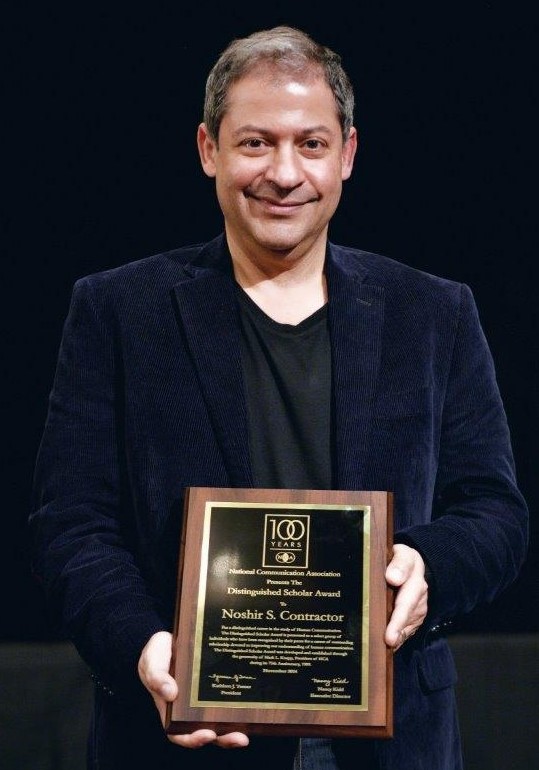
The NCA Distinguished Scholar Award was created in 1991 to recognize and reward NCA members for a lifetime of scholarly achievement in the study of human communication. Recipients are selected to showcase the communication profession. The award is supported by the Mark L. Knapp Distinguished Scholar Fund. Since 1992, those recognized as NCA Distinguished Scholars nominate and elect members to join this select group.
Twitter Opens the Archive
Twitter announced last week that it will now make all tweets since the launch of the site in 2006 publically searchable to all users. Although the new search function is still in the works, this massive archive of tweets could mean more accessible datasets for social network researchers. From this day forward, Twitter’s search engine will index roughly half a trillion tweets.
Read more at the Twitter blog.
Why Some High Schools Have More Cliques
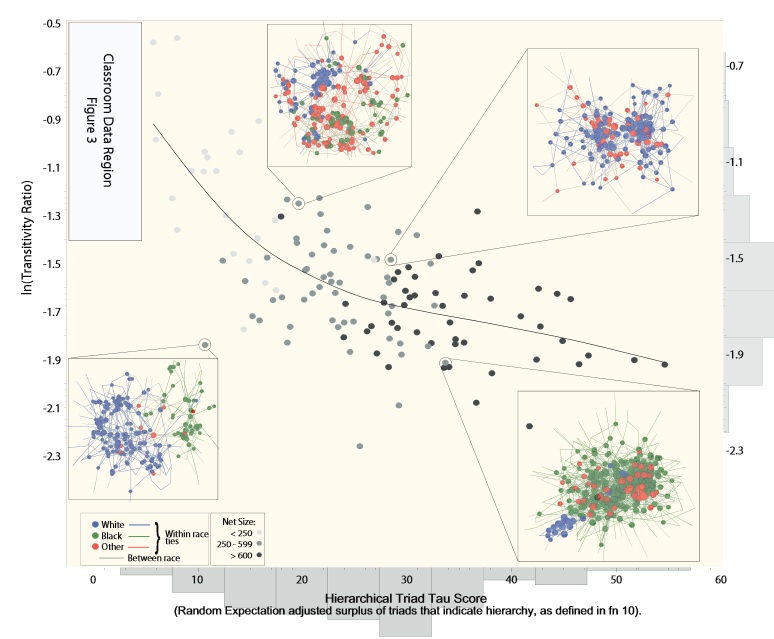
Hierarchy, and Size, with Exemplars
(McFarland, p. 17)
McFarland used two different datasets (one looking at classroom level and one looking at school level friendships) to analyze the network ecology of tie formation. His team found that larger school size and greater freedom to choose activities resulted in more homophily, while small school size and a more prescriptive curriculum resulted in greater integration.
However, they point out that student bodies rarely fall into just one camp – instead, both types of systems may exist within the same institution. Rabinovitz-Stanford explains: “A bigger and more diverse student population may well foster self-segregation, but a smaller and more elite school is almost inherently more segregated in the first place.” In the words of McFarland: “The truth is that we are not sure which kind of adolescent society is best for youth social development…There likely isn’t a simple answer.”
News Article
Full Journal Article
Paper by Alina Lungeanu and Noshir Contractor titled “The Effects of Diversity and Network Ties on Innovations: The Emergence of a New Scientific Field” published in the American Behavioral Scientist journal
Article available at: http://abs.sagepub.com/content/early/2014/11/14/0002764214556804
Noshir Contractor participated in a panel titled “Big Data: Opportunities and Implications for Wireless Health” at the Wireless Health 2014 Scientific Conference on October 31, 2014 at the National Institutes of Health in Bethesda, MD
Noshir Contractor participated in a panel at the Innovative Assessment of Collaboration 2014 workshop organized by Educational Testing Services in Washington DC on November 3, 2014
New SONIC Blog Entry: Only the Strongest Ties Matter
While both strong and weak ties have their place in social networks, which type better supports team collaboration and problem solving?
Using Network Modeling to Predict Traffic
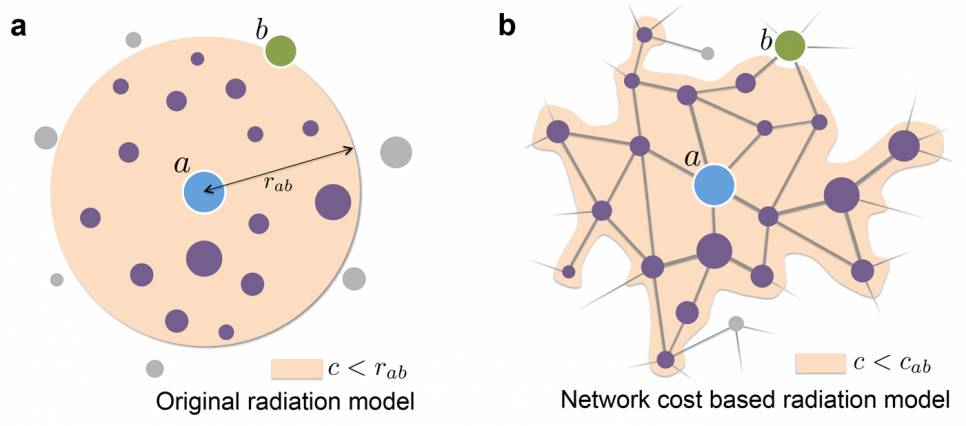 A team of researchers from MIT and Notre Dame are using an innovative modeling approach to predict the flow of traffic. This new model takes into account potential changes that may occur in the network (eg. construction or road closures), and is better able to deal with such changes than previous versions of the model. In the future, similar models could be applied to any network flows that include human choices.
“This work fills a gaping hole in our understanding of — and ability to predict — network flows,” says Stephen Eubank of the Network Dynamics and Simulation Science Lab.
For the full article, see here.
CANCELLED: Prasad Balkundi to present in the SONIC Speaker Series Nov. 18
Due to the adverse weather, this talk has unfortunately been cancelled.
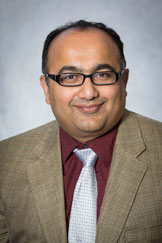
SONIC Lab is proud to welcome Prasad Balkundi who will present a talk on Tuesday, November 18, 2014 at 2:00 P.M. in SONIC Lab in the Frances Searle Building room 1.459.
All are welcome to attend. To schedule a one-on-one meeting with a Dr. Balkundi please schedule a time here. Please contact Nancy McLaughlin with any questions/comments.
Culture, Labor Markets and Attitudes: A Meta-analytic Test of Tie-Strength Theory
Although the strength-of-weak-tie theory is foundational in social network research, studies have reported inconsistent results sometimes supporting the weak tie theory and other times contradicting it. To address these inconsistencies, we explicate three boundaries of weak-tie theory: Culture, labor markets and outcomes. First, the theory was developed and tested extensively in western nations, raising the issue of whether cultural context affects outcomes. Second, the theory was tested using lower-level applicants finding jobs across organizations, raising the issue as to the applicability of the theory for job movement within organizations for high-ranking employees. Third, beyond the question of finding a job, the question arises as to strength-of-tie effects on a broader set of outcomes such as access to information and job attitudes. Based on a meta-analysis of 101 studies (n = 23,303) we found that strong ties were more potent than weak ties in conformist cultures. Second, strong ties within the organization were more beneficial than weak ties. Also, managers benefitted more from strong ties. Third, strong ties facilitated immediate effectiveness and positive job attitudes whereas weak ties enhanced distal effectiveness for low-end employees.
About Prasad Balkundi
Dr. Prasad Balkundi is an Associate Professor in the Organization and Human Resources Department in the School of Management at the University of Buffalo. He received his Ph.D. in business administration from Pennsylvania State University. His research interests include social networks and leadership in teams and his work has appeared in the Academy of Management Journal, Academy of Management Review, Journal of Applied Psychology and Leadership Quarterly.