Original Article:

Summary:
Konaris et al at the National Technical University of Athens in Greece expanded on existing legal network analysis by extracting “all the documents from the European Community’s legal database dating back to 1951” and organizing the texts into three subnetworks: treaties between countries, regulations and directives that are based on these treaties, and case laws that have emerged from the application of these regulations. Analysis of each subsection showed that “all were small world networks in themselves” that generally demonstrate high levels of resilience. This model produced a novel perspective because it takes into account both the temporal dynamism and hierarchical nature of European law. In addition to mapping citations (references that do not modify the target document) Konaris also represented legal bias (edit references that modify either the text or the lifecycle of the target document) and accounted for their effects over time. This revealed “a steep increase in the density of links within the network over time”. Ultimately, Konaris suggests that the clusters and related connections illustrated by this work may “help legislators determine the effect of proposed changes and improve the effectiveness of legal information retrieval”.
Paper:

 Cuba has been in the headlines recently with the president Obama’s decision to lift the 55-year-long trade embargo on the country.
 Ivan Hernandez is a collaborative post-doctoral researcher at Northwestern University and the Georgia Institute of Technology. He received his B.S. in Psychology from the University of Florida, and his PhD in Social Psychology at the University of Illinois at Urbana-Champaign.
 SONIC Lab is proud to welcome
  In recent years, the spread of information over social networks has become a global phenomenon. Scientists have begun to study how information spreads from person to person, and how individuals’ motivations can cause a cascade effect in behavior. Researchers note that often “cascading behavior in a social network is guided by an entity that wants to achieve a certain outcome, for example… a political movement might be trying to guide the success of its message in a population.”
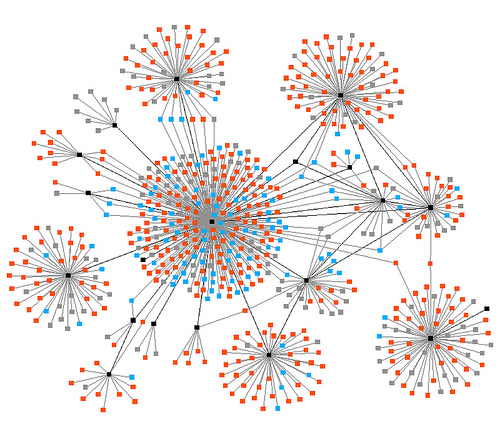 The study of the network of networks, or interdependent networks, has become increasingly important. Interdependent networks are hugely prevalent especially in food, water, and fuel delivery systems. Scientists at Northeastern, Beihang, and Bar-Ilan Universities wrote in the National Science Review that the study of network of networks is “one of the most important directions in network science”.
 What makes one a good group member? Is it intelligence? A recent study found that, “having a lot of intelligent people in the group did not necessarily mean that your group will have sure success.”