Prasad Balkundi to Present in SONIC Speaker Series on May 7th, 2015

Prasad BalkundiSONIC Lab is proud to welcome Prasad Balkundi, who will present a talk on Thursday, May 7th, 2015 at 2:00 PM in the SONIC Lab in the Frances Searle Building 1-459. All are welcome to attend. To schedule a one-on-one meeting with Professor Balkundi please schedule a time here. Please contact Nancy McLaughlin with any questions or comments.

Culture, Boundaries and Attitudes: A Meta-Analytic Test of Tie-Strength Theory

Although the strength-of-weak-tie theory is foundational in social network research, studies have reported inconsistent results sometimes supporting the weak tie theory and other times contradicting it. To address these inconsistencies, we explicate three boundaries of weak-tie theory: culture, labor markets, and outcomes. First, the theory was developed and tested extensively in Western nations, raising the issue of whether cultural context affects outcomes. Second, the theory was tested using lower-level applicants finding jobs across organizations, raising the issue as to the applicability of the theory for job movement within organizations for high-ranking employees. Third, beyond the question of finding a job, the question arises as to strength-of-tie effects on a broader set of outcomes such as access to information and job attitudes. Based on a meta-analysis of 101 studies (n = 23,303) we found that strong ties were more potent than weak ties in conformist cultures. Second, strong ties within the organization were more beneficial than weak ties. Also, managers benefitted more from strong ties. Third, strong ties facilitated immediate effectiveness and positive job attitudes whereas weak ties enhanced distal effectiveness for low-end employees.

About Prasad Balkundi

Prasad Balkundi is an associate professor of management at the University at Buffalo, State University of New York. He received his PhD in business administration from Pennsylvania State University. His research interests include social networks and leadership in teams and his work has appeared in the Academy of Management Journal, Academy of Management Review, Journal of Applied Psychology and Leadership Quarterly.

[line]

Strong vesus weak: A meta-analysis of tie strength and individual effectiveness

Continue Reading

Balazs Vedres to Present in SONIC Speaker Series on April 22nd, 2015

Balazs VedresSONIC Lab is proud to welcome Balazs Vedres, who will present a talk on Wednesday, April 22nd, 2015 at 10:00 AM in the SONIC Lab in the Frances Searle Building 1-459. All are welcome to attend. To schedule a one-on-one meeting with Professor Vedres please schedule a time here. Please contact Nancy McLaughlin with any questions or comments.

Escaping Network Gravity: Innovative Team Structures in Video Game Development and Recorded Jazz

The main mechanisms governing social tie formation and operation are at odds with recognizing new ideas. Homophily, closure, skewed degree distributions, and limited vision are four main forces of network gravity. This talk brings cases where these gravity forces were overcome by organizational design and emergent institutions. Using data on more than 100,000 video game developers from the 1980’s to the present, and 400,000 jazz musicians from 1890 to the present I show mechanisms of achieving generative tension, productive diversity, and sustained exploration. I will highlight the role of structural folds, and the significance of overlapping yet cognitively diverse communities.

About Balazs Vedres

Vedres’ research furthers the agenda of understanding historical dynamics in network systems, combining insights from network science, historical sociology, and studies of complex systems in physics and biology. His contribution is to combine historical sensitivities to patterns of processes in time with a network analytic sensitivity to patterns of connectedness cross-sectionally. A key element of this work was the adoption of optimal matching sequence analysis to historical network data. His research results were published in the top journals of sociology, with two recent articles in the American Journal of Sociology exploring the notion of structural folds: creative tensions in intersecting yet cognitively diverse cohesive communities. Vedres’ recent research follows video game developers and jazz musicians as they weave collaborative networks through their projects and recording sessions. Vedres is the recipient of several awards and prizes. He is the founder and director of the Center for Network Science at Central European University.

[line]

Escaping Network Gravity

Continue Reading

Libby Hemphill to Present in SONIC Speaker Series on April 16th, 2015

Libby HemphillSONIC Lab is proud to welcome Libby Hemphill, who will present a talk on Thursday, April 16th, 2015 at 2:00 PM in the SONIC Lab in the Frances Searle Building 1-459. All are welcome to attend. To schedule a one-on-one meeting with Professor Hemphill please schedule a time here. Please contact Nancy McLaughlin with any questions or comments.

What Can Congress’s Twitter Use Teach Us About Framing and Polarization?

Social media offers politicians an opportunity to bypass traditional media and directly influence their audience’s opinions and behavior through issue framing. I examine how members of the U.S. Congress use Twitter to accomplish framing and explore the effects of their behavior on mainstream media coverage. Social media also offers researchers trace data for detecting topic communities and political polarization that would otherwise not be revealed until legislative votes take place. I will discuss how my colleagues and I used politicians’ social media behavior, especially the affiliation networks that result from their hashtag use, to create new measures of political polarization that make it possible for us to gauge polarization throughout the legislative process.

About Libby Hemphill

Libby (PhD, University of Michigan) directs the CaSM Lab. She is an Assistant Professor of Communication and Information Studies at the Illinois Institute of Technology. Libby is broadly interested in computer-mediated communication, social media, digital humanities, and organizational behavior.

[line]

What can Congress’s Twitter use teach us about framing and polarization?

Continue Reading

Noshir Contractor Delivers Presentation at Northwestern University Office for Sponsored Research

At the Northwestern Office for Sponsored Research (NU OSR) in Evanston, Illinois on February 27th, Noshir Contractor delivered a Brown Bag presentation titled “Using Computational Social Science to Address Grand Societal Challenges”. The office is Northwestern’s arm for assisting and developing funded programs in support of the university’s research mission.

Learn more about the Office for Sponsored Research

Continue Reading

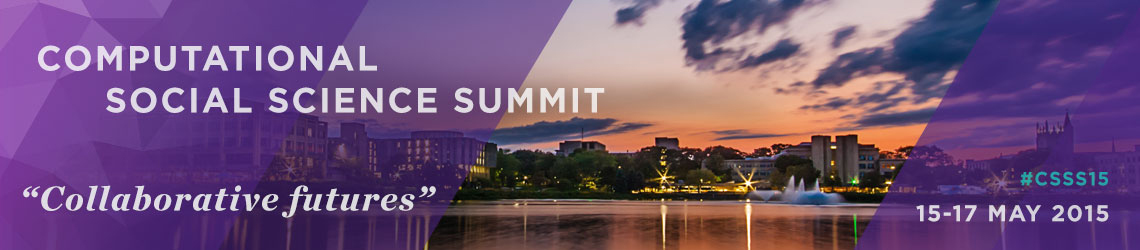
2015 Computational Social Science Conference Coming to NU

Northwestern University’s Kellogg School of Management is hosting the Computational Social Science Conference from May 15th to 17th. The purpose of the summit is to advance sociological knowledge through computational methods. The conference will host workshops, a datathon, and prominent speakers such as David Ferrucci (Bridgewater Associates), Katy Börner (Indiana University), Sandra González-Bailón (University of Pennsylvania), and Michael Macy (Cornell University). The conference is for social science researchers, open data activists, tech workers, and think tank analysts and is co-hosted by Northwestern Institute on Complex Systems and SONIC.

Learn more about the conference and events

Continue Reading

Noshir Contractor Delivers Keynote Address at nPOD

At the nPOD Annual Conference on February 22nd in St. Pete Beach, Florida, Noshir Contractor delivered the keynote address on “The Science of Team Science” in the biomedical field. The agenda of the conference elaborated: “To learn about how collaborations work, we have one of the country’s experts on the topic of ‘The Science of Team Science’ giving a lecture on multidisciplinary, international collaborations, their impact in the biomedical field, and how Team Science works.”

Learn more about the conference and keynote address

Continue Reading

SONIC Proudly Welcomes New Postdoc, Ivan Hernandez

IvanHernandezIvan Hernandez is a collaborative post-doctoral researcher at Northwestern University and the Georgia Institute of Technology. He received his B.S. in Psychology from the University of Florida, and his PhD in Social Psychology at the University of Illinois at Urbana-Champaign.

He is currently working on the Gates Project here at SONIC.

http://sonic.northwestern.edu/people/postdocs-graduate_students/ivan-hernandez/


Continue Reading

Dan Newman to Present in SONIC Speaker Series – Jan. 29th

dannewmanSONIC Lab is proud to welcome Dan Newman, who will present a talk on January 29th, 2015 at 2:00 P.M. in SONIC Lab in the Frances Searle Building, room 1.459. All are welcome to attend. To schedule a one-on-one meeting with a Dr. Newman please schedule a time at http://bit.ly/SonicSpeaker. Please contact Nancy McLaughlin with any questions/comments.

Statistical Power to Detect Social Network Effects in Small Groups
One handy method for modeling social network contagion effects (i.e., using peer attributes to predict the focal actors’ attributes) is the spatial lag or spatial autocorrelation model. Wang, Neuman, and Newman (2014) demonstrated that in order to attain adequate statistical power to detect such social network effects, networks researchers will often need data from a modest-sized network of 40 or more persons. This poses a problem when one’s theoretical focus is on social contagion/network effects in small groups and teams, for which the membership is often much smaller than N = 40. Using simulation methods, I seek to extend the work of Wang et al. (2014) to investigate how many groups/teams are needed in order to reliably detect social network contagion in small group

About Dr. Newman
Daniel A. Newman, Ph.D., is an Associate Professor in the Department of Psychology and the School of Labor & Employment Relations at the University of Illinois at Urbana-Champaign. His research deals with race and gender diversity in HR management (i.e., adverse impact, hiring/minority recruiting), emotional intelligence (what it is and why it relates to job performance), narcissism (why it relates to leadership, counterproductive work behavior, and gender), and research methods (missing data, multilevel approaches, Bayesian meta-analysis). He has been elected Chair of the Research Methods Division of the Academy of Management, and his work has been recognized with the Academy of Management HR Division’s Scholarly Achievement Award, SIOP’s William A. Owens Scholarly Achievement Award, and the Research Methods Division’s McDonald Award for Advancement of Organizational Research Methodology, Sage Best Paper Award, Best Reviewer of the Year Award, and Early Career Award. He received the Faculty Teaching Excellence Award from the School of Labor & Employment Relations in 2013.
Continue Reading