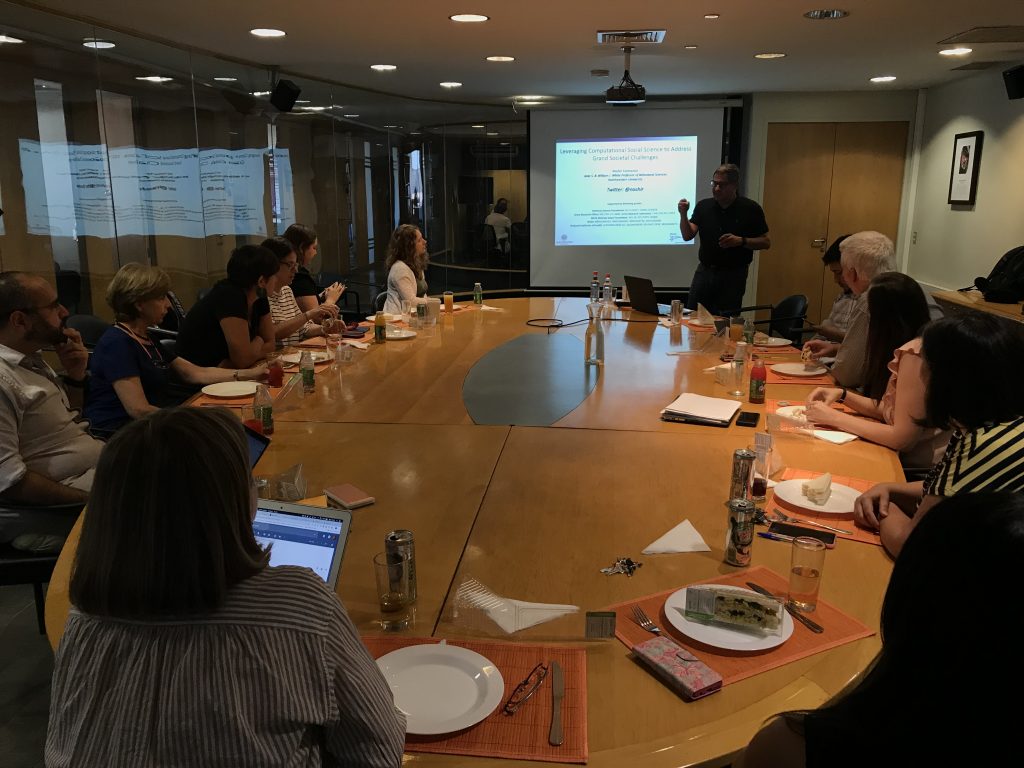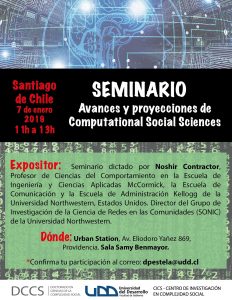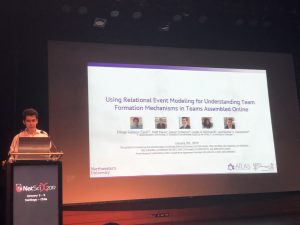
Diego Gómez-Zará presents, “Using relational event modeling for understanding team formation mechanisms in teams assembled online” at the central winter conference on Network Science, NetSci-X, in Santiago, Chile. This conference brings together leading researchers and innovators to connect, meet and establish interdisciplinary channels for collaboration. From biological and environmental networks, to social, technological and economic networks, NetSci-X 2019 links the Chilean spirit with the fresh outlook of Network Science.
Citation:
Diego Gómez-Zará, Matthew Paras, Aaron Schecter, Leslie A. DeChurch and Noshir S. Contractor. (2019, January). Using relational event modeling for understanding team formation mechanisms in teams assembled online. Paper presented at the International School and Conference on Network Science (NetSci-X), Santiago, Chile.
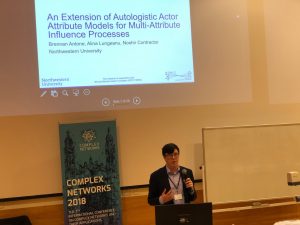
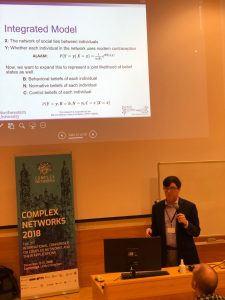
Brennan Antone presents work with Alina Lungeanu and Noshir Contractor at the Complex Networks 2018 Conference in Cambridge, U.K. He spoke about extensions to autologistic actor attribute models for multi-attribute influence processes to better understand modern contraceptive usage in Kenyan villages.
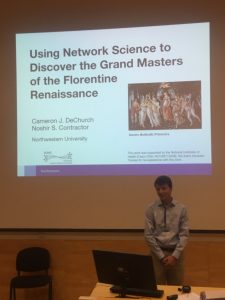
Dec 11, 2018 – SONIC summer intern, Cameron DeChurch, presented at the 7th International Conference on Complex Networks and Their Applications. This summer he used historical records to construct digital networks of the collaboration among Florentine Renaissance painters. His paper with Noshir Contractor, “Using Network Science to Discover the Grand Masters of the Florentine Renaissance” finds that rather than the household names of Michelangelo and DaVinci, it was the grand masters like Verrochio and Perugino who ultimately had more impact through their lineage, by training painters who would go on to produce great works.
Citation:
DeChurch, C.J., & Contractor, N.S. (2018, December). Using Network Science to Discover the Grand Masters of the Florentine Renaissance. Paper presented at theInternational Conference on Complex Networks and Their Applications. Cambridge, U.K.
When Lebron James, Dwyane Wade, and Chris Bosh signed with the National Basketball Association’s (NBA) Miami Heat in 2010 as free agents, basketball fans and sports pundits heralded the arrival of the league’s first “super team.” Yet despite boasting a starting lineup featuring three of the league’s best players, the Heat began the 2011 season with a disappointing 9-8 record as its stars acclimated to their new roles as teammates.
Looking back at the team’s inauspicious start, Northwestern Engineering’s Noshir Contractor isn’t surprised.
“Of course, individual players on a team make a difference, but so much focus is spent on finding those with the most talent,” Contractor said. “Other factors, like how people get along together or how well they trust each other, suggest that teams are not just an aggregation of individuals and their attributes, but also the relationships that exist previously among them.”
Noshir Contractor
Contractor, the Jane S. and William J. White Professor of Behavioral Sciences and professor of industrial engineering and management sciences in the McCormick School of Engineering, worked with a team of researchers to put this paradigm to the test. Analyzing statistical data from professional sports leagues and online games, the group has found that past shared success among team members improves their odds of winning future games — findings that have implications far beyond the sports arena, into business and even space research.
The study, titled “Prior shared success predicts victory in team competitions,” was published December 3 in the journal Nature Human Behaviour. Satyam Mukherjee, assistant professor at the Indian Institute of Management Udaipur and former postdoctoral fellow within the Northwestern Institute on Complex Systems, served as the paper’s corresponding author. Contractor and Brian Uzzi, Richard L. Thomas Professor of Leadership and Organizational Change at the Kellogg School of Management and (by courtesy) industrial engineering and management sciences at Northwestern Engineering, were the paper’s co-authors.
Previously reported by ALEX GERAGE in McCormick School of Engineering News
Brent Hoagland, lab manager, presented his master’s thesis, “The Plumbing of Wall Street: a case study of a hedge fund’s back-office,” at the Futures of Finance and Society Conference at the University of Edinburgh.
A recent article “Betweenness to assess leaders in criminal networks: New evidence using the dual projection approach” by Rosanna Grassi, Francesco Calderoni, and Monica Bianchi show the performance of different betweenness centrality measures in identifying criminal leaders in a meeting participation network. Each of the measures reports different ranking of leaders and dual projection based approaches show better performance compared to traditional betweenness or flow-based measures. Read more:
At the North American Regional Social Networks (NASN) Conference of the International Network for Social Network Analysis (INSNA) in Washington, D.C., Contractor spoke as a panel member to discuss common and complementary themes, approaches, and open problems across the major field of network sciences — primarily focussing on the bridges between social network analysis (SNA) and network science (NS), but also addressing other fields such as complex systems (CS), computational social science (CSS) and areas of computer and information sciences (CS, IS).
Moody, J., Contractor, N., Phillips, N., Young, L. (2018, November). Complementarity of the Network Sciences: distinctions, tensions and synergies across SNA, NS and the other system sciences. Panel member at the North American Regional Social Networks (NASN) Conference of the International Network for Social Network Analysis (INSNA), Washington, D.C.
Nov 28, 2018 – SONIC summer intern, Cameron DeChurch, presented at the North American Regional Social Networks (NASN) Conference of the International Network for Social Network Analysis (INSNA) today. This summer he used historical records to construct digital networks of the collaboration among Florentine Renaissance painters. His paper with Noshir Contractor, “Using Network Science to Discover the Grand Masters of the Florentine Renaissance” finds that rather than the household names of Michelangelo and DaVinci, it was the grand masters like Verrochio and Perugino who ultimately had more impact through their lineage, by training painters who would go on to produce great works.
Citation:
DeChurch, C.J., & Contractor, N.S. (2018, November). Using Network Science to Discover the Grand Masters of the Florentine Renaissance. Paper presented at the North American Regional Social Networks Conference. Washington, D.C.