Kyosuke Tanaka’s paper accepted to #ComplexNetworks2018 conference

SONIC research graduate, Kyosuke will be traveling to Cambridge, UK for the Complex Networks 2018 conference. A paper by Kyosuke Tanaka and Agnes Horvat, an Assistant Professor in Communication Studies at Northwestern, has been accepted and will also be included in the conference proceedings.
Their paper, titled “Network Strategies and Efficiency in Human Communication Networks,” explains the effect of networking strategies on efficiency in communication networks. Tanaka and Horvat use data-driven computer simulations to examine how manipulations in the form of added, deleted, strengthened and weakened communication channels alter the local and global efficiency of communication networks. Their results indicate that there is a clear trade-off between networking strategies and efficiency. Their findings reassess conventional wisdom about the effectiveness of networking strategies.
Citation: Tanaka, K., & Horvát, E-Á. In Press. Networking Strategies and Efficiency in Human Communication Networks. Proceedings The 7th International Conference on Complex Networks and Their Applications COMPLEX NETWORKS 2018.
Continue Reading

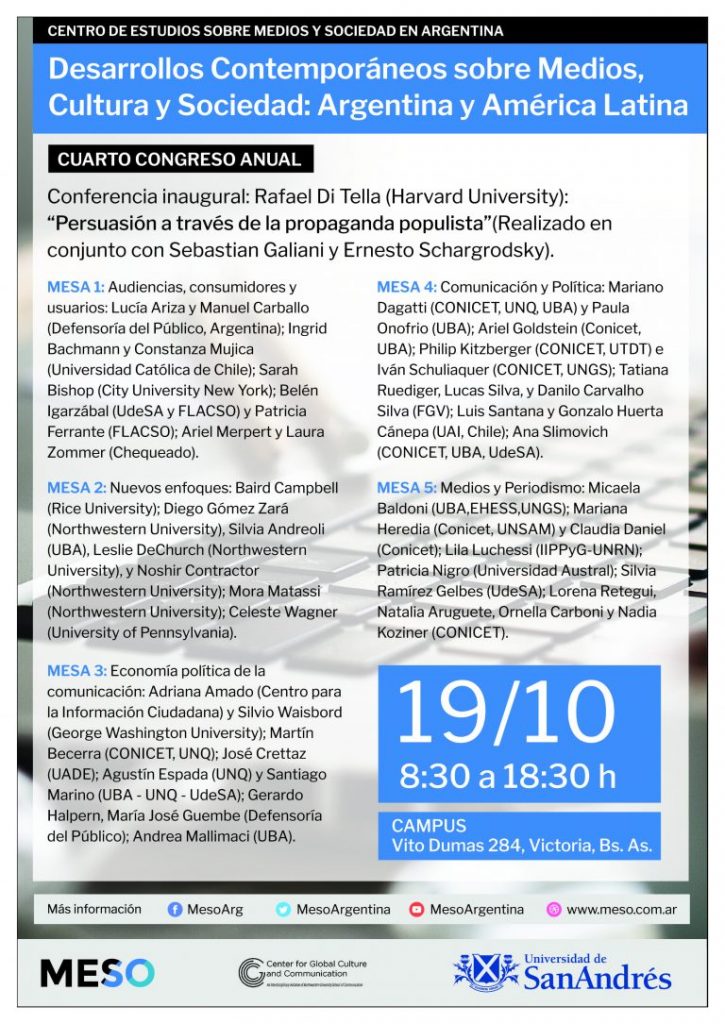
Diego Gómez-Zará presents at MESO 2018

Diego Gómez-Zará, a Ph.D. student in Technology and Social Behavior, is going to present at the Center for the Study on Media and Society in Argentina (MESO), University of San Andrés. The presentation is titled “How can we assemble better interdisciplinary teams? The ‘My Dream Team’ experience at the Universidad of Buenos Aires.” Prof. Noshir Contractor, Prof. Leslie DeChurch, and Silvia Andreoli co-authored this presentation.

He will present the My Dream Team research project conducted at Universidad de Buenos Aires in 2017. The panels will deal with topics such as networks, culture, political communication, the entertainment industry, among other topics. There will be presentations from scholars affiliated with universities throughout the region.

Continue Reading

Complexity Explorables by Dirk Brockmann

Complexity Explorables is a website where people easily explore some complex systems examples while playing models with fun.

For example, “I herd you!” enables you to explore how different network structures impact the spread of a disease in a population. Consequently, you can understand a phenomenon called “herd immunity”, defined that “a disease can be eradicated even if not the entire population is immunized.” The webpage is simple, yet very informative.

If you’re interested, there are many other examples and models. Check them out at http://www.complexity-explorables.org/explorables/!

Continue Reading

Cameron DeChurch & Noshir Contractor will present their paper in Cambridge

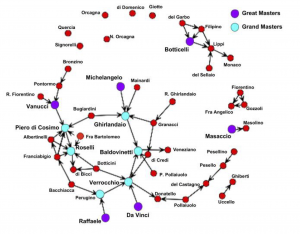
SONIC summer research intern Cameron DeChurch will be traveling to Cambridge, UK to present his paper at the Complex Networks 2018 conference. This summer he used historical records to construct digital networks of the collaboration among Florentine Renaissance painters. His paper with Noshir Contractor, “Using Network Science to Discover the Grand Masters of the Florentine Renaissance” finds that rather than the household names of Michelangelo and DaVinci, it was the grand masters like Verrochio and Perugino who ultimately had more impact through their lineage, by training painters who would go on to produce great works.
  
Citation:
DeChurch, C.J., & Contractor, N.S. (2018, December). Using Network Science to Discover the Grand Masters of the Florentine Renaissance. Paper presented at the International Conference on Complex Networks and Their Applications. Cambridge, UK.
Continue Reading

Welcome! New SONIC Members

Welcome!

Yuanxin Wang is a visiting scholar from Peking University. She will be working on the Enterprise Social Media project, and her research interests include social media, social network analysis, market and media analysis, and user behavior. She graduated from Beijing Normal University with a B.A. in Communications.

Dongping Zhang is a first-year Ph.D. student in Technology & Social Behavior. His research interests include social network analysis, structural estimation, machine learning, big data, and computational social science. He will be contributing to the Enterprise Social Media project. Dongping graduated from the University of Chicago with an M.A. in Computational Social Science and from UC Berkeley with a B.A. in Statistics and a B.A. in Economics.

Niloufar Izadinia is a second year Ph.D. student in Industrial Engineering and Management Sciences. Her research interests include social network analysis, optimization, and data science. Niloufar will work on the NASA CREWS (Project RED Optimization). She graduated from the University of Technology, Tehran, Iran with an M.S. in Industrial Engineering.

Brent Hoagland finished his M.A. in Social Sciences from the University of Chicago and will support the SONIC and ATLAS labs with administrative and operational research tasks. He plans to continue graduate school in the near future with research interests in economic sociology, social studies of finance & accounting, social network analysis, and sociology of knowledge.


Continue Reading

SONIC at IEEE/ACM ASONAM in Barcelona

Generative Modeling of Human Behavior and Social Interactions Using Abductive Analysis

Abstract:

Abduction is an inference approach that uses data and observations to identify plausible (and preferably, best) explanations for phenomena. Applications of abduction (e.g., robotics, genetics, image understanding) have largely been devoid of human behavior. Here, we devise and execute an iterative abductive analysis process that is driven by the social sciences: behaviors and interactions among groups of human subjects. One goal is to understand intra-group cooperation and its effect on fostering collective identity. We build an online game platform; perform and analyze controlled laboratory experiments; form hypotheses; build, exercise, and evaluate network-based agent-based models; and evaluate the hypotheses in multiple abductive iterations, improving our understanding as the process unfolds. While the experimental results are of interest, the paper’s thrust is methodological, and indeed establishes the potential of iterative abductive looping for the (computational) social sciences.

Ren, Y., Cedeno-Mieles, V., Hu, Z., Deng, X., Adiga, A., Barrett, C. L., et al. (2018). Generative Modeling of Human Behavior and Social Interactions Using Abductive Analysis (pp. 1–8). Presented at the International Conference on Advances in Social Network Analysis and Mining, 2009. ASONAM ’09.


Continue Reading

Seniors’ usage of mobile social network sites

Seniors’ usage of mobile social network sites: Applying theories of innovation diffusion and uses and gratifications

Continue Reading

SONIC Lab presented at Academy of Management 2018

On August 11-14, Professor Noshir Contractor and SONIC Alumna Jacqueline Ng presented at the 2018 Academy of Management Conference held in Chicago, Illinois.

Contractor, N. S.
Some Assembly Required: Teaming in the 21st Century.
Paper presented at the
Innovations in Teaching Teamwork PDW Workshop

Contractor, N. S.
Multi-theoretical multilevel models of networks.
Paper presented at the
Introduction to Social Network Analysis PDW Workshop.

Mukherjee, A., Xiao, P. & Wang, L., & Contractor, N. S.
Does the opinion of the crowd predict success? 
Paper presented at the Crowd and Cloud Session.

Ng, J., & Contractor, N.S.
Social Media & Team Collaboration: How the @mention Feature Facilitates and Constrains Teamwork
Paper presented at AOM.

Continue Reading