SONIC and ATLAS members attended the 2017 NASA Investigators’ Workshop in Galveston, TX

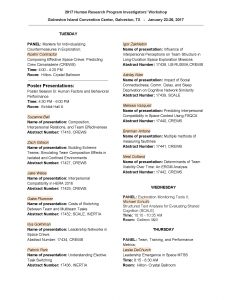
SONIC and ATLAS members: eight graduate students, one undergraduate researcher, and two post-doctoral researchers attended the NASA Human Research Program Investigators’ Workshop in Galveston, TX from January 23rd – January 26th.


Our team, together with our collaborators at DePaul, was showcasing eleven posters and presenting on three panels.

You can see the seven SONIC and ATLAS posters here:

Gabe Plummer: The Costs of Switching Between Team and Multiteam Tasks and The Role of Shared Cognition

Brennan Antone: Faulty Analysis: Analyzing Different Faultline Measurement Algorithms for Long-Duration Space Exploration

Zach Gibson: Building Extreme Teams: Simulating team Composition Effects in Isolated and Confined Environments

Patrick Park: Understanding Elective Task Switching

Ashley Niler:  Impact of Social Connectedness, Communication Delay, and Sleep Deprivation on Cognitive Network Similarity in Analog Teams

Ilya Gokhman: Leadership Networks in Space Crews

Igor Zakhlebin: Influence of Interpersonal Perceptions on Team Structure in Long-Duration Space Exploration Missions


Continue Reading

SONIC PhD candidate Aaron Schecter and Noshir Contractor presented at the Network Science of Squads Workshop

On Sunday, December 4th, a SONIC PhD candidate Aaron Schecter and Professor Noshir Contractor presented at a workshop titled “The Network Science of Squads“, held in Denton, TX on December 3rd – 5th.

An illustration of the relational event model to analyze group interaction processes

Abstract

A fundamental assumption in the study of groups is that they are constituted by various interaction processes that are critical to survival, success, and failure. However, there are few methods available sophisticated enough to empirically analyze group interaction. To address this issue, we present an illustration of relational event modeling (REM). A relational event is a “discrete event generated by a social actor and directed toward one or more targets.” Because REM provides a procedure for modeling relational event histories, it has the ability figure out which patterns of group interaction are more or less common than others. For instance, do past patterns of interaction influence future interactions, (e.g., reciprocity), do individual attributes make it more likely that individuals will create interactions (e.g., homophily), and do specific contextual factors influence interaction patterns (e.g., a complexity of a task)? The current presentation provides an REM tutorial from a multi-team system experiment in which two teams navigated a terrain to coordinate their movement to arrive a common destination point. We use REM to model the dominant patterns of interactions, which included the principle of inertia (i.e., past contacts tended to be future contacts) and trust (i.e., group members interacted with members they trusted more) in the current example.

Continue Reading

Noshir Contractor gives a keynote address at the 3rd GESIS Computational Social Science Winter Symposium

On December 1st, 2016, Noshir Contractor presented on Leveraging Computational Social Science to Address Grand Societal Challenges. The symposium, titled “Understanding social systems via computational approaches and new kinds of data”, took place from November 30 – December 1, 2016 at KOMED im MediaPark, Cologne, Germany

The complete schedule of presentations and Noshir’s talk abstract can be viewed following the link below:

http://www.gesis.org/css-wintersymposium/program/schedule/

Continue Reading

Twitter bots “Trumping” during this election

How the Bot-y Politic Influenced This Election:

Nearly 20 percent of all election-related tweets come from an army of influential robots.
Read the full article here.


Trump’s Twitter Bots Turned Out on Election Day:

Throughout the campaign, automated propaganda accounts on Twitter leaned Republican, but that disparity increased in the race’s final days.
Continue Reading

SONIC Speaker Series Presents: Ingmar Weber

SONIC Lab is proud to welcome Ingmar Weber who will present a talk on Wednesday, November 16th, 2016 at 10:00 AM in Frances Searle Building, Room 1-459. Please contact SONIC Lab Manager Katya Bitkin with any questions or comments.

Demographics in Social Networks: Usage Differences, Content Spread, and Homophily

Abstract

????????????????????????????????????
 

How do demographic attributes affect network structure and content spread? In this talk, I’ll present attempts to address this question using a demographically annotated data set for 350K Twitter users in New York. For each user, their gender, age and race has been inferred from their profile picture using Face++. I’ll start by  showing that population-level differences in hashtag usage are intuitive, such as African Americans being more likely to use #blacklivesmatter, women more likely to use #makeup, and young people more likely to use #growingupwithsiblings. Taking ideas previously studied in the context of web search, we then look at  which demographic groups are generally first – or last – to use new hashtags. Here we find that, e.g., new music-related hashtags tend to originate from African American users, whereas new baseball hashtags come from white men. Looking at the topic of “algorithmic bias”, we show that the “what’s trending” tends to favor the majority group, potentially creating hurdles for minority content to benefit from system-induced feedback. Finally, I’ll show results related to racial link asymmetries, potentially indicating latent discrimination.

The work presented is joint work with Jisun An at QCRI, and several members of the Social Dynamics Lab (http://sdl.soc.cornell.edu/) at Cornell University, including Michael Macy, George Berry, Minsu Park and Chris Cameron. The research varies in terms of doneness from “medium well” to “rare”. More information on past projects at http://ingmarweber.de/publications/.

Biography

Ingmar Weber is a senior scientist in the Social Computing Group at the Qatar Computing Research Institute (QCRI) in Doha. He uses large amounts of online data to address research questions of societal relevance related to (i) lifestyle diseases, (ii) societal fragmentation, and (iii) international migration. He has published over 100 peer-reviewed articles (http://ingmarweber.de/publications/) and his work is frequently featured in the popular press (https://www.google.com/search?tbm=nws&q=%22ingmar+weber%22). Since April 2016 he’s been selected as an ACM Distinguished Speaker.

Stream the full presentation here:

Continue Reading

How Network Neuroscience Is Creating a New Era of Mind Control

Complex networks form the backbone of modern society: the Internet, the aviation network, the pattern of connections between individuals. And more complex examples are constantly emerging—the way genes interact in cells, how information flows through the banking system and the ecosystem.

The more complex the system, the harder it is to control. mind-controlNevertheless, computer scientists, doctors, economists and the like exercise a modicum of control over many of these networks.

And that raises an interesting question: is it possible to exercise the same kind of control over the most complex network we know of: the human brain?

Read the complete article here

Continue Reading