Runner-up: “Best Student Paper” Award

Congratulations to a SONIC graduate student Marlon Twyman who received a Runner-up: “Best Student Paper” Award at the INGRoup 2016 conference for this presentation:

Marlon Twyman, Dan Newman, Leslie DeChurch, and Noshir Contractor. The Ties that Form Teams: Self-Organization, Homophily, and Multiplexity. 11th Annual INGRoup Conference, Helsinki, Finland , July 14-16, 2016.

Abstract:

This paper explains the unfolding process of team assembly – the behaviors involved as individuals consider and form relationships with potential teammates. We explore the role of self-organizing principles, homophily, and multiplexity in explaining how individuals choose their collaborators. Findings reveal multiplexity is a stronger predictor of team assembly than homophily.

Continue Reading

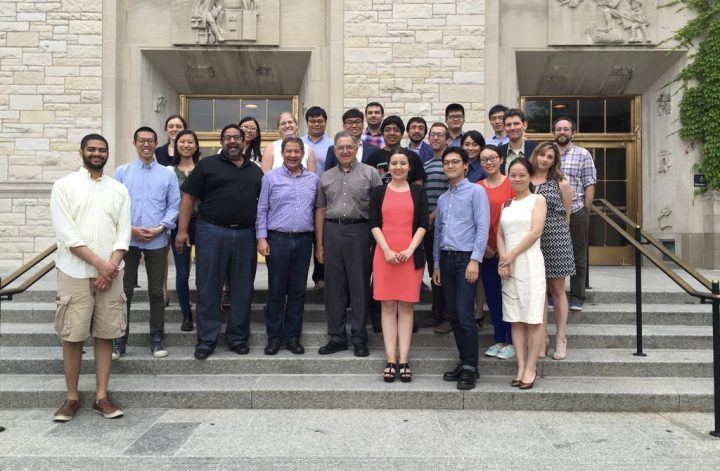
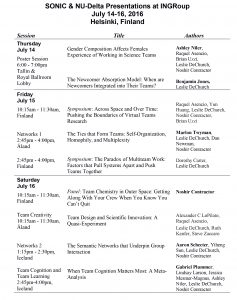
SONIC and NU-Delta members presented at the INGRoup conference on July 14-16 in Helsinki, Finland

SONIC and NU-Delta members presented at the INGRoup conference on July 14-16 in Helsinki, Finland.

Abstracts for posters and presentations are listed below the schedule.
 

INGROUP2016 presentationsLG


Gender Composition Affects Females Experience of Working in Science Teams

Ashley Niler, Raquel Asencio, Leslie DeChurch, Brian Uzzi, Noshir Contractor

Success in scientific fields hinges on effective collaboration. Whereas females excel in communal settings, they are underrepresented in scientific fields, and on science teams. We find the percentage of females on a team affects females’ level of team identification and collective efficacy, and subsequently team performance.


The Newcomer Absorption Model: When are Newcomers Integrated into Their Teams?

Benjamin Jones, Leslie DeChurch

This study explores newcomer absorption in teams from the perspective of the incumbents, and how they adapt to the newcomer’s addition to the team. Findings support the idea that incumbent identity strength and the identity threat posed by the newcomer jointly undermine newcomer absorption.


Symposium: Across Space and Over Time: Pushing the Boundaries of Virtual Teams Research

 Raquel Asencio, Yun Huang, Leslie DeChurch, Noshir Contractor, Brian Uzzi

Globalization and advancements in communication technology have encouraged the use of virtual teams; however, our knowledge of the dynamics and the implications of working across geographic, organizational, and time boundaries remains limited. Our symposium pushes the boundaries of research on virtual teams by exploring new topics and utilizing different methods.


The Ties that Form Teams: Self-Organization, Homophily, and Multiplexity

Marlon Twyman, Leslie DeChurch, Dan Newman, Noshir Contractor

This paper explains the unfolding process of team assembly – the behaviors involved as individuals consider and form relationships with potential teammates. We explore the role of self-organizing principles, homophily, and multiplexity in explaining how individuals choose their collaborators. Findings reveal multiplexity is a stronger predictor of team assembly than homophily.


Symposium: The Paradox of Multiteam Work: Factors that Pull Systems Apart and Push Teams Together

 Dorothy Carter, Leslie DeChurch

Multiteam systems present a paradox of building strong component teams that function effectively as a larger system. This symposium examines factors pulling these systems apart and pushing component teams together. The papers take important next steps in advancing MTS research to new levels of theoretical precision and into new contexts. 


Panel: Team Chemistry in Outer Space: Getting Along With Your Crew When You Know You Can’t Quit

 Noshir Contractor

One of the riskiest group projects in history is being planned – a manned trip to Mars. This panel focuses on the composition of teams selected for long-duration space missions. It will consider what groups research across multiple disciplines can tell us about high performing teams in space missions


Team Design and Scientific Innovation: A Quasi-Experiment

 Alexander C LoPilato, Raquel Asencio, Leslie DeChurch, Ruth Kanfer, Steve Zaccaro

There are two important realities of innovation, and together, they present a formidable paradox: innovation happens in teams, and various flavors of diversity have been shown to hinder team functioning. We manipulate team design to compare integration and innovation in two structures: a cross-functional team and an interdisciplinary multiteam system.


The Semantic Networks that Underpin Group Interaction

 Aaron Schecter, Yiheng Sun, Leslie DeChurch, Noshir Contractor

Semantic network analysis combined with content and sentiment analysis affords new insights into the nature of group interaction. We illustrate the value of semantic network analysis as a small group research tool. For example, we find group members match one another’s social, analytic, and informational communication, but not the emotionality.


When Team Cognition Matters Most: A Meta-Analysis

 Gabriel Plummer, Lindsay Larson, Jessica Mesmer-Magnus, Ashley Niler, Leslie DeChurch, Noshir Contractor

We uncover the operating conditions under which cognition is most critical to team success. Five key factors affect the instrumentality of team cognition to team affect, behavioral process, performance, and viability. These factors can be categorized as: team identity reinforcers, team stressors, team motivators, team sociomateriality, and team external embeddedness.

 

Continue Reading

Noshir Contractor Gives Keynote Address at 2016 Web Science Summer School in Koblenz, Germany

Noshir Contractor gave a keynote address at the 2016 annual Web Science Summer School held in Koblenz, Germany. Click here for the event page and click here to download slides from the presentation.

Abstract:

The increased access to big data about social phenomena in general, and network data in particular, has been a windfall for social scientists. But these exciting opportunities must be accompanied with careful reflection on how big data can motivate new theories and methods. Using examples of his research, Contractor will argue that Web/Internet/Network Sciences (WINS) serve as the foundation to unleash the intellectual insights locked in big data. More importantly, he will illustrate how these insights offer social scientists an unprecedented opportunity to engage more actively in monitoring, anticipating and designing interventions to address grand societal challenges.koblenz

Continue Reading

SONIC is Proud to Co-organize the 2nd International Conference on Computational Social Science at Northwestern University

SONIC is proud to co-organize the 2nd International conference on Computational Social Science by the Kellogg School of Management, Northwestern University.

IC2S2 event attendees are granted the option to select to participate in one of our Pre-Sessions, participating in either the Datathon on June 22-23, or the Skills Workshops on June 24.

IC2S2 2016 is the combination of two inaugural computational science conferences, the Computational Social Science Summit (last held May 15-17, 2015 in Evanston, Ill.) and the International Conference on Computational Social Science (last held June 8-11, 2015 in Helsinki, Finland).

Find additional information about the event by clicking here. 

ksm-css-international-hero-home-1140x250-rev1

Continue Reading

Congratulations to Anne Xie, for winning second place prize at the Undergrad Research Expo’s Social Sciences & Humanities

Congratulations to Anne Xie, for winning second place prize at the Undergrad Research Expo’s Social Sciences & Humanities poster session!

Under the help of Yun Huang‘s feedback, she was granted second place for her “Development of Social Relationships in Massively Multiplayer Online Role-Playing Games” poster expo.

Once again, congratulations Anne! The SONIC lab members are very proud of you!

Screen Shot 2016-06-06 at 2.27.42 PM

Continue Reading

“Toward a better scientific collaboration success prediction model through the feature space expansion” published in the International Journal, Scientometrics

Toward a better scientific collaboration success prediction model through the feature space expansionby Fahimeh Ghasemian, Kamran Zamanifar, Nasser Ghasem-Aqaeeand Noshir Contractor were published in Scientometrics. The article highlights the problem with the prediction of scientific collaboration success based on the previous collaboration of scholars using machine learning techniques is addressed in this study. As the exploitation of collaboration network is essential in collaborator discovery systems, in this article an attempt is made to understand how to exploit the information embedded in collaboration networks. We benefit the link structure among the scholars and also among the scholars and the concepts to extract set of features that are correlated with the collaboration success and increase the prediction performance. The effect of considering other aggregate methods in addition to average and maximum, for computing the collaboration features based on the feature of the members is examined as well. A dataset extracted from Northwestern University’s SciVal Expert is used for evaluating the proposed approach. The results demonstrate the capability of the proposed collaboration features in order to increase the prediction performance in combination with the widely-used features like h-index and average citation counts. Consequently, the introduced features are appropriate to incorporate in collaborator discovery systems.

You can read the publication here.

Full citation:

Ghasemian, F., Zamanifar, K., Ghasem-Aqaee, N., & Contractor, N. (2016). Toward a better scientific collaboration success prediction model through the feature space expansion. Scientometrics, (1-25). doi: 10.1007/s11192-016-1999-x

Screen Shot 2016-06-06 at 11.10.37 AM

Screen Shot 2016-06-06 at 10.59.46 AM

Continue Reading

Noshir Contactor Meets with Fellow Web Science Trust Lab Directors in Germany

WSTNet Lab Directors got together at the start of the Web Science Conference this week in Hannover, Germany. Highlights of the meeting include the election of Steffen Staab as Chair and Pete Burnap as Vice-Chair, planning for this years’ Web Science Summer School at University of Koblenz (30 June to 6 July – ), and firming up of arrangements for World Wide Web Week – a global event celebrating 10 years of Web Science to be held later this year.

Read the full article here.

Lab Director, Noshir Contractor, is a founding member of the Web Science Trust initiative.

WST Lab Directors


Continue Reading

Noshir and Colleagues Receive Outstanding Contribution Award for their paper “A Network Approach for Understanding and Analyzing Product Co-consideration Relations in Engineering Design”

Noshir Contractor and colleagues; Wei Chen, Mingxian Wang, Yun Huang and Yan Fu received an Outstanding Contribution Award for being one of ten papers that were rated in the top 5% based on reviewers’ scores. Professor Wei Chen presented the findings of the paper in a Keynote presentation at the 14th International Design Conference.

For more information on the grant that funded this project check out the following grant page.

Reference:

Wang, M., Huang, Y., Contractor, N., Fu. Y., and Chen, W., “A Network Approach for Understanding and Analyzing Product Co-consideration Relations in engineering Design”, 14th International Design Conference, May 16-19 2016, Cavtat, Dubrovnick, Croatia.

Screen Shot 2016-05-24 at 12.53.28 PM

Continue Reading

Noshir Contractor Gives Keynote Address at the University of Colorado, Denver’s 4th Annual Network Leadership Training Academy

Noshir Contractor gave the keynote address at the University of Colorado, Denver’s 4th Annual Network Leadership Training Academy, titled  “Building and Leveraging Powerful Social Networks”. Click here for a link to the event page.

Description:
The Network Leadership Training Academy (NLTA) is a place where network leaders gather to learn, share ideas, and develop skills for engaging in the “network way of working.” This 3-day workshop, hosted by the University of Colorado Denver’s Center on Collaborative Governance, is focused on building, managing, and evaluating effective networks. Many people today are deeply involved in the network way of working, but are struggling to find tools and a place to build skills and a community for this new way of connecting across boundaries. This interactive workshop is based on the premise that everyone involved in a network requires network leadership skills in order to be an active, effective member of a collaborative network. he agenda for the 2016 NLTA is packed full of opportunities for attendees to share and learn from each other’s experiences and skills, as well as research and tools to translate back to practice. Our keynote address on Building and Leveraging Powerful Social Networks features Dr. Noshir Contractor, Professor at Northwestern University and Director of the Science of Networks in Communities (SONIC) research center. He will share his work on investigating factors that lead to the formation, maintenance, and dissolution of dynamically linked social and knowledge networks in a wide variety of contexts. Large group sessions will be led by NLTA core trainers who are recognized for their contributions to network science research. Session topics include: · Managing Networks, Brint Milward, Ph.D, University of Arizona · Network Way of Working: Building a Network Culture, Janice Popp, MSW, RSW, University of Calgary · Affective Contagion in Networks: Evaluating Process Quality, Darrin Hicks, PhD, University of Denver · Evaluating Networks as Systems, Danielle Varda, PhD, University of Colorado Denver Other session topics include: Networks 101, Using PARTNER’s Social Network Analysis Tool to Evaluate your Networks, Networks as Policy Tools: “Network Nuggets” from Research and Practice, Facilitation Skills, Conflict Training, and Collective Impact.

Continue Reading