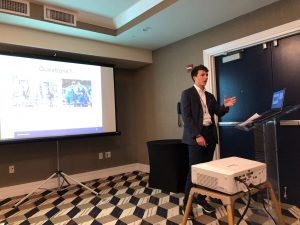
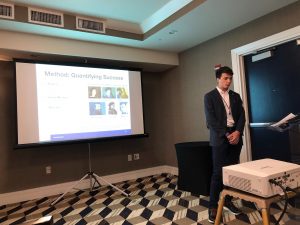
Dec 11, 2018 – SONIC summer intern, Cameron DeChurch, presented at the 7th International Conference on Complex Networks and Their Applications. This summer he used historical records to construct digital networks of the collaboration among Florentine Renaissance painters. His paper with Noshir Contractor, “Using Network Science to Discover the Grand Masters of the Florentine Renaissance” finds that rather than the household names of Michelangelo and DaVinci, it was the grand masters like Verrochio and Perugino who ultimately had more impact through their lineage, by training painters who would go on to produce great works.
Citation:
DeChurch, C.J., & Contractor, N.S. (2018, December). Using Network Science to Discover the Grand Masters of the Florentine Renaissance. Paper presented at theInternational Conference on Complex Networks and Their Applications. Cambridge, U.K.
When Lebron James, Dwyane Wade, and Chris Bosh signed with the National Basketball Association’s (NBA) Miami Heat in 2010 as free agents, basketball fans and sports pundits heralded the arrival of the league’s first “super team.” Yet despite boasting a starting lineup featuring three of the league’s best players, the Heat began the 2011 season with a disappointing 9-8 record as its stars acclimated to their new roles as teammates.
Looking back at the team’s inauspicious start, Northwestern Engineering’s Noshir Contractor isn’t surprised.
“Of course, individual players on a team make a difference, but so much focus is spent on finding those with the most talent,” Contractor said. “Other factors, like how people get along together or how well they trust each other, suggest that teams are not just an aggregation of individuals and their attributes, but also the relationships that exist previously among them.”
Noshir Contractor
Contractor, the Jane S. and William J. White Professor of Behavioral Sciences and professor of industrial engineering and management sciences in the McCormick School of Engineering, worked with a team of researchers to put this paradigm to the test. Analyzing statistical data from professional sports leagues and online games, the group has found that past shared success among team members improves their odds of winning future games — findings that have implications far beyond the sports arena, into business and even space research.
The study, titled “Prior shared success predicts victory in team competitions,” was published December 3 in the journal Nature Human Behaviour. Satyam Mukherjee, assistant professor at the Indian Institute of Management Udaipur and former postdoctoral fellow within the Northwestern Institute on Complex Systems, served as the paper’s corresponding author. Contractor and Brian Uzzi, Richard L. Thomas Professor of Leadership and Organizational Change at the Kellogg School of Management and (by courtesy) industrial engineering and management sciences at Northwestern Engineering, were the paper’s co-authors.
Previously reported by ALEX GERAGE in McCormick School of Engineering News
Brent Hoagland, lab manager, presented his master’s thesis, “The Plumbing of Wall Street: a case study of a hedge fund’s back-office,” at the Futures of Finance and Society Conference at the University of Edinburgh.
A recent article “Betweenness to assess leaders in criminal networks: New evidence using the dual projection approach” by Rosanna Grassi, Francesco Calderoni, and Monica Bianchi show the performance of different betweenness centrality measures in identifying criminal leaders in a meeting participation network. Each of the measures reports different ranking of leaders and dual projection based approaches show better performance compared to traditional betweenness or flow-based measures. Read more:
At the North American Regional Social Networks (NASN) Conference of the International Network for Social Network Analysis (INSNA) in Washington, D.C., Contractor spoke as a panel member to discuss common and complementary themes, approaches, and open problems across the major field of network sciences — primarily focussing on the bridges between social network analysis (SNA) and network science (NS), but also addressing other fields such as complex systems (CS), computational social science (CSS) and areas of computer and information sciences (CS, IS).
Moody, J., Contractor, N., Phillips, N., Young, L. (2018, November). Complementarity of the Network Sciences: distinctions, tensions and synergies across SNA, NS and the other system sciences. Panel member at the North American Regional Social Networks (NASN) Conference of the International Network for Social Network Analysis (INSNA), Washington, D.C.
Nov 28, 2018 – SONIC summer intern, Cameron DeChurch, presented at the North American Regional Social Networks (NASN) Conference of the International Network for Social Network Analysis (INSNA) today. This summer he used historical records to construct digital networks of the collaboration among Florentine Renaissance painters. His paper with Noshir Contractor, “Using Network Science to Discover the Grand Masters of the Florentine Renaissance” finds that rather than the household names of Michelangelo and DaVinci, it was the grand masters like Verrochio and Perugino who ultimately had more impact through their lineage, by training painters who would go on to produce great works.
Citation:
DeChurch, C.J., & Contractor, N.S. (2018, November). Using Network Science to Discover the Grand Masters of the Florentine Renaissance. Paper presented at the North American Regional Social Networks Conference. Washington, D.C.
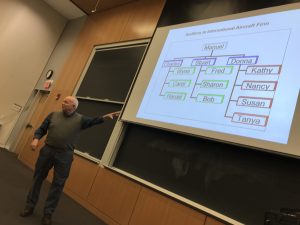
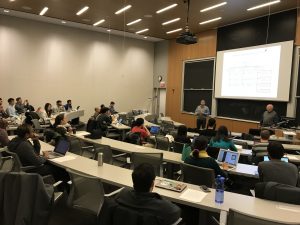
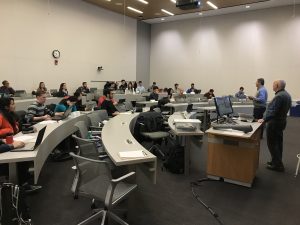
Professor Krackhardt of Carnegie Mellon guest lectured the Master of Science in Analytic’s class. Krackhard pioneered the concept of “cognitive social structures.” In the lecture, he shared some of his case studies and discussed how an individual’s power can be measured according to his/her position in the whole network structure. He provided network visualizations and demonstrated how they can provide better insights into analyzing an individual’s power.
This past weekend at the National Communication Association (NCA) 104th Annual Convention, Contractor provided mentorship during the sessions titled “Scholarly Recess: Professional Development for Students and Junior Scholars” for the Group Communication Division and “Pursuing Grant-Funded Research in Communication: Challenges and Opportunities across the Discipline.” He also served as a respondent for the Top Papers session for the Group Communication Division.
Alina presented the paper, “Deep Space Collaboration: Impact of Communication Latency on Collaborative Work” at the NCA 104th Annual Convention in Salt Lake City, UT.
Citation:
Lungeanu, A., Park, P., DeChurch, L. A., & Contractor, N. S. (2018, November). Deep Space Collaboration: Impact of Latency and Social Networks on Collaborative Work. Paper presented at the NCA 104th Annual Convention, Salt Lake City, UT.
By Giovanni Luca Ciampaglia, Azadeh Nematzadeh, Filippo Menczer & Alessandro Flammini
Algorithms that favor popular items are used to help us select among many choices, from top-ranked search engine results to highly-cited scientific papers. The goal of these algorithms is to identify high-quality items such as reliable news, credible information sources, and important discoveries–in short, high-quality content should rank at the top. Prior work has shown that choosing what is popular may amplify random fluctuations and lead to sub-optimal rankings. Nonetheless, it is often assumed that recommending what is popular will help high-quality content “bubble up” in practice. Here we identify the conditions in which popularity may be a viable proxy for quality content by studying a simple model of a cultural market endowed with an intrinsic notion of quality. A parameter representing the cognitive cost of exploration controls the trade-off between quality and popularity. Below and above a critical exploration cost, popularity bias is more likely to hinder quality. But we find a narrow intermediate regime of user attention where an optimal balance exists: choosing what is popular can help promote high-quality items to the top. These findings clarify the effects of algorithmic popularity bias on quality outcomes, and may inform the design of more principled mechanisms for techno-social cultural markets.
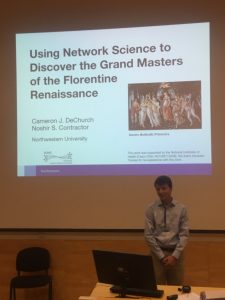 Dec 11, 2018 – SONIC summer intern, Cameron DeChurch, presented at the 7th International Conference on Complex Networks and Their Applications. This summer he used historical records to construct digital networks of the collaboration among Florentine Renaissance painters. His paper with Noshir Contractor, “Using Network Science to Discover the Grand Masters of the Florentine Renaissance” finds that rather than the household names of Michelangelo and DaVinci, it was the grand masters like Verrochio and Perugino who ultimately had more impact through their lineage, by training painters who would go on to produce great works.