Nebula was selected as a finalist for the IMS Global Consortium Learning Impact Award that was held on May 16-19 2017. Most of the competition was professional educational tech applications. See the full list of Winners of the 2017 Learning Impact Awards here, where Nebula is listed among the 2017 Honorable Mentions.
Congratulations to Jackie Ng and Noshir Contractor – SONIC contributors to Nebula!
Nebula is a Northwestern alternative to the standard Canvas discussion board. Nebula is a hybrid type of learning tool that at once offers analytic visualization of complex discussion dynamics and invites participation in that dynamic by having users contribute posts and comments directly to the discussion graph. Its visual approach is very intuitive to understand and use, promoting more rapid and frequent student engagement in the discussions.
https://vimeo.com/213856028
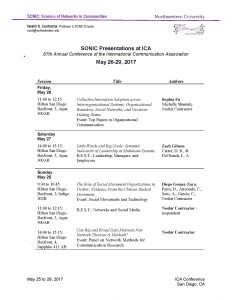
On May 28th, the Ph.D. student Diego Gómez-Zará presented his research on social movements at the 67th conference of the International Communication Association (ICA). This year, the conference was hosted in San Diego, USA. Diego presented on “The Role of Social Movement Organizations in Twitter: Evidence From the Chilean Student Movement.” By using a mixed-methods approach, incorporating network analysis, sentiment analysis, and content analysis, the study identifies differences in how social movements’ information flow, network position, and attitudes evolve.
On may 30th, 2017 Leslie DeChurch will present at the Mars Mission Social Sciences Workshop at the Buzz Aldrin Space Institute in Cape Canaveral, FL. The title of her paper, co-authored with Noshir Contractor and Michael Schultz, is SCALE: Shared cognitive architecture for long-term exploration.
Noshir Contractor and two SONIC graduate students: Diego Gomez Zara, and Zachary Gibson are going to present at the 67th Annual Conference of the International Communication Association (ICA) on May 25-29 in San Diego, CA.
One of the papers, co-authored by Noshir Contractor, will be presented at the Top Paper Panel for the Organizational Communication Division:

On May 18, 2017 SONIC Director Noshir Contractor gave a Gerald P. Mohrmann Memorial Lecture on Leveraging Computational Social Science to Address Grand Societal Challenges.
The increased access to big data about social phenomena in general, and network data in particular, has been a windfall for social scientists. But these exciting opportunities must be accompanied with careful reflection on how big data can motivate new theories and methods. Using examples of his research in the area of networks, Contractor will argue that Computational Social Science serves as the foundation to unleash the intellectual insights locked in big data. More importantly, he will illustrate how these insights offer social scientists in general, and social network scholars in particular, an unprecedented opportunity to engage more actively in monitoring, anticipating and designing interventions to address grand societal challenges.
Ralf Schmälzlea,b, Matthew Brook O’Donnellb , Javier O. Garciac , Christopher N. Casciob , Joseph Bayerd , Danielle S. Bassette,f, Jean M. Vettelc,e,g, and Emily B. Falkb,1 a Department of Communication, Michigan State University, East Lansing, MI 48824; b Annenberg School for Communication, University of Pennsylvania, Philadelphia, PA 19104; c Human Research and Engineering Directorate, US Army Research Laboratory, Aberdeen Proving Ground, MD 21005; d School of Communication, The Ohio State University, Columbus, OH 43210; e Department of Bioengineering, University of Pennsylvania, Philadelphia, PA 19104; f Department of Electrical & Systems Engineering, University of Pennsylvania, Philadelphia, PA 19104; and g Department of Psychological and Brain Sciences, University of California, Santa Barbara, CA 93106
Social ties are crucial for humans. Disruption of ties through social exclusion has a marked effect on our thoughts and feelings; however, such effects can be tempered by broader social network resources. Here, we use fMRI data acquired from 80 male adolescents to investigate how social exclusion modulates functional connectivity within and across brain networks involved in social pain and understanding the mental states of others (i.e., mentalizing). Furthermore, using objectively logged friendship network data, we examine how individual variability in brain reactivity to social exclusion relates to the density of participants’ friendship networks, an important aspect of social network structure. We find increased connectivity within a set of regions previously identified as a mentalizing system during exclusion relative to inclusion. These results are consistent across the regions of interest as well as a whole-brain analysis. Next, examining how social network characteristics are associated with task-based connectivity dynamics, we find that participants who showed greater changes in connectivity within the mentalizing system when socially excluded by peers had less dense friendship networks. This work provides insight to understand how distributed brain systems respond to social and emotional challenges and how such brain dynamics might vary based on broader social network characteristics.
Read the full article here.
On Friday, April 28th, Noshir and Leslie presented a paper Exploring New Frontiers: Building Better Teams on Earth and Beyond in a symposium at the 2017 SIOP conference in Orlando, Florida.
Jacqueline Ng, Brennan Antone, Zachary Gibson, Suzanne T. Bell, Leslie A. DeChurch, Noshir Contractor: Crew Recommender for Effective Work in Space: CREWS
The prospect of sending a team to Mars by the year 2030 challenges organizational scientists to build new conceptual lenses and leverage advanced analytic and computational methods to hasten understanding and prediction of team performance. This symposium showcases 5 recent advances, all inspired by the challenge of space exploration.
by Anna Gorman
Lynn Whittaker stood in the hallway of her home looking at the framed photos on the wall. In one, her son Andrew is playing high school water polo. In another, he’s holding a trombone. The images show no hint of his life today: the seizures that leave him temporarily paralyzed, the weakness that makes him fall over, his labored speech, his scrambled thoughts. Andrew, 28, can no longer feed himself or walk on his own. The past nine years have been a blur of doctor appointments, hospital visits, and medical tests that have failed to produce answers.
“You name it, he doesn’t have it,” his mother said.
Andrew has never had a clear diagnosis. He and his family are in a torturous state of suspense, hanging their hopes on every new exam and evaluation. Recently, they have sought help from the Undiagnosed Diseases Network, a federally funded coalition of universities, clinicians, hospitals, and researchers dedicated to solving the nation’s toughest medical mysteries. The doctors and scientists in the network harness advances in genetic science to identify rare, sometimes unknown, illnesses.
Read the full article here.
Noshir Contractor gave the opening keynote address at the 5th Annual Network Leadership Training Academy, titled “Building and Leveraging Powerful Social Networks” on April 26th. The Academy is organized by the Center on Network Science at the University of Colorado, Denver. For more details, see http://bit.ly/NLTA2017.