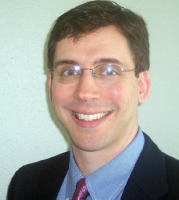
SONIC Lab is proud to welcome
Dan Newman, who will present a talk on
January 29th, 2015 at 2:00 P.M. in SONIC Lab in the Frances Searle Building, room 1.459. All are welcome to attend. To schedule a one-on-one meeting with a Dr. Newman please schedule a time at
http://bit.ly/SonicSpeaker. Please contact
Nancy McLaughlin with any questions/comments.
Statistical Power to Detect Social Network Effects in Small Groups
One handy method for modeling social network contagion effects (i.e., using peer attributes to predict the focal actors’ attributes) is the spatial lag or spatial autocorrelation model. Wang, Neuman, and Newman (2014) demonstrated that in order to attain adequate statistical power to detect such social network effects, networks researchers will often need data from a modest-sized network of 40 or more persons. This poses a problem when one’s theoretical focus is on social contagion/network effects in small groups and teams, for which the membership is often much smaller than N = 40. Using simulation methods, I seek to extend the work of Wang et al. (2014) to investigate how many groups/teams are needed in order to reliably detect social network contagion in small group
About Dr. Newman
Daniel A. Newman, Ph.D., is an Associate Professor in the Department of Psychology and the School of Labor & Employment Relations at the University of Illinois at Urbana-Champaign. His research deals with race and gender diversity in HR management (i.e., adverse impact, hiring/minority recruiting), emotional intelligence (what it is and why it relates to job performance), narcissism (why it relates to leadership, counterproductive work behavior, and gender), and research methods (missing data, multilevel approaches, Bayesian meta-analysis). He has been elected Chair of the Research Methods Division of the Academy of Management, and his work has been recognized with the Academy of Management HR Division’s Scholarly Achievement Award, SIOP’s William A. Owens Scholarly Achievement Award, and the Research Methods Division’s McDonald Award for Advancement of Organizational Research Methodology, Sage Best Paper Award, Best Reviewer of the Year Award, and Early Career Award. He received the Faculty Teaching Excellence Award from the School of Labor & Employment Relations in 2013.

 “The world is going to teamwork. In the 1950s, about half of our work was done in teams. Today, by one measure, it’s more like 90 percent. Maybe it’s at the office. Maybe it’s on Google Hangout. Maybe it’s at the PTA. But what makes a good team? A smart team? It’s not just a bunch of smart people, says a big new study. It’s a crew that shares the floor, the talking time, it claims. It’s a team that has high social sensitivity. And it’s often, it says, a team with more women. We need a cultural revolution, they say, to optimize our teams. This hour On Point: Are you onboard? We’re talking teamwork.” -Tom Ashbrook

 Cuba has been in the headlines recently with the president Obama’s decision to lift the 55-year-long trade embargo on the country.
 Ivan Hernandez is a collaborative post-doctoral researcher at Northwestern University and the Georgia Institute of Technology. He received his B.S. in Psychology from the University of Florida, and his PhD in Social Psychology at the University of Illinois at Urbana-Champaign.
 In recent years, the spread of information over social networks has become a global phenomenon. Scientists have begun to study how information spreads from person to person, and how individuals’ motivations can cause a cascade effect in behavior. Researchers note that often “cascading behavior in a social network is guided by an entity that wants to achieve a certain outcome, for example… a political movement might be trying to guide the success of its message in a population.”
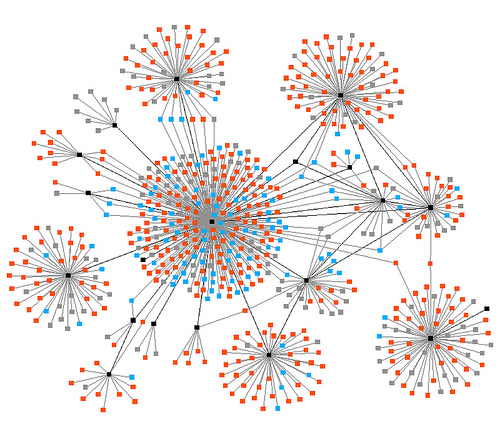 The study of the network of networks, or interdependent networks, has become increasingly important. Interdependent networks are hugely prevalent especially in food, water, and fuel delivery systems. Scientists at Northeastern, Beihang, and Bar-Ilan Universities wrote in the National Science Review that the study of network of networks is “one of the most important directions in network science”.
 What makes one a good group member? Is it intelligence? A recent study found that, “having a lot of intelligent people in the group did not necessarily mean that your group will have sure success.”