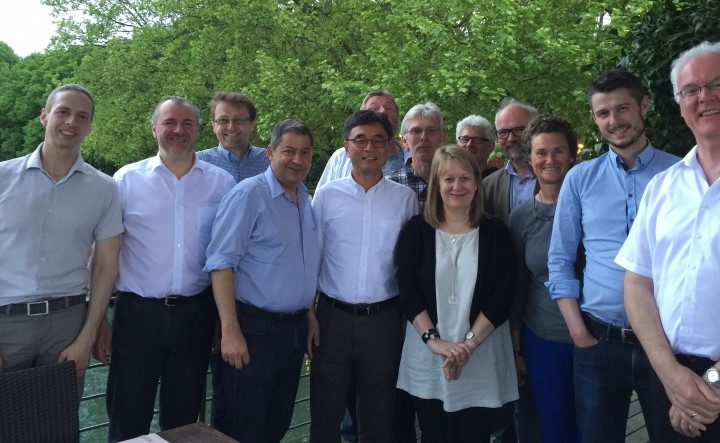
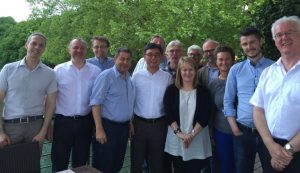
Noshir Contractor along with collaborators Suzanne Bell (DePaul University) and Leslie DeChurch (currently at Georgia Tech, but soon to be at Northwestern University) have received another grant from the National Aeronautics and Space Administration in order to study the relationship between composition, interpersonal relations, and team effectiveness in space crews. This project will be jointly conducted with researchers at Institute of Biomedical Problems, whose research informs operations for the Russian Federal Space Agency. In this US-Russian collaboration, researchers will utilize data previously collected in the Mars 105 and Mars 500 simulations; collect new data using analog-definition research in the 2017 and 2018 Human Exploration Research Analog (HERA) campaigns; and use a novel combination of text mining, relational event modeling, and coevolution statistical modeling.
For more information on this exciting new project, click here.
This is the second collaborative NASA grant among Prof. Contractor, Prof. DeChurch, and Prof. Bell; the first being CREWS: Crew Recommender for Effective Work in Space. This is also the fourth NASA grant the SONIC Lab has received in the past two years. Be sure to check out our work on the other two grants: SCALE and INERTIA!
A team of researchers at Northeastern University, led by famous networks researcher and physicist Albert-Laszlo Barabasi, explored how the concept of sustainability can be implemented in network analysis. The researchers approached this idea by defining the concept of control energy or “the amount of effort needed to control real-world complex systems.” They reported that this new metric can be utilized in all kinds of real-world complex systems, such as identifying critical points in online network security systems. By using this new metric, a cost benefit analysis could be administered in order to identify exactly how much external energy needs to be inputted into drivers’ nodes in order to create the most efficient complex system.
SONIC Lab is proud to welcome Robert Ackland who will present his talk on Tuesday, April 10th, 2016 at 9:00 AM in Frances Searle Building, Room 3-417. All are welcome to attend. To schedule a one-on-one meeting with Dr. Ackland please schedule a time HERE. Join our Facebook Event HERE.
Please contact Eric Forbush with any questions or comments.
Frames and Fields on Twitter
Associate Professor School of Sociology Centre for Social Research & Methods ANU College of Arts and Social Sciences
Abstract
We characterize an online activist field as a social arena in which participants vie for the definition of the most urgent cause or risk issue. We ask the question: to what extent is it conceptually and empirical valid to regard protest activity on Twitter, such as the Occupy Wall Street movement, as an online activist field? Network analysis is used to examine two core aspects of field theory: the behavior of incumbents vs new entrants in response to a new issue or frame, and the dynamics of field formation. This project extends earlier research concerning organizations involved in environmental social movements and online collective identity formation and contributes to emerging research on activism in the era of the “networked individual”.
Biography
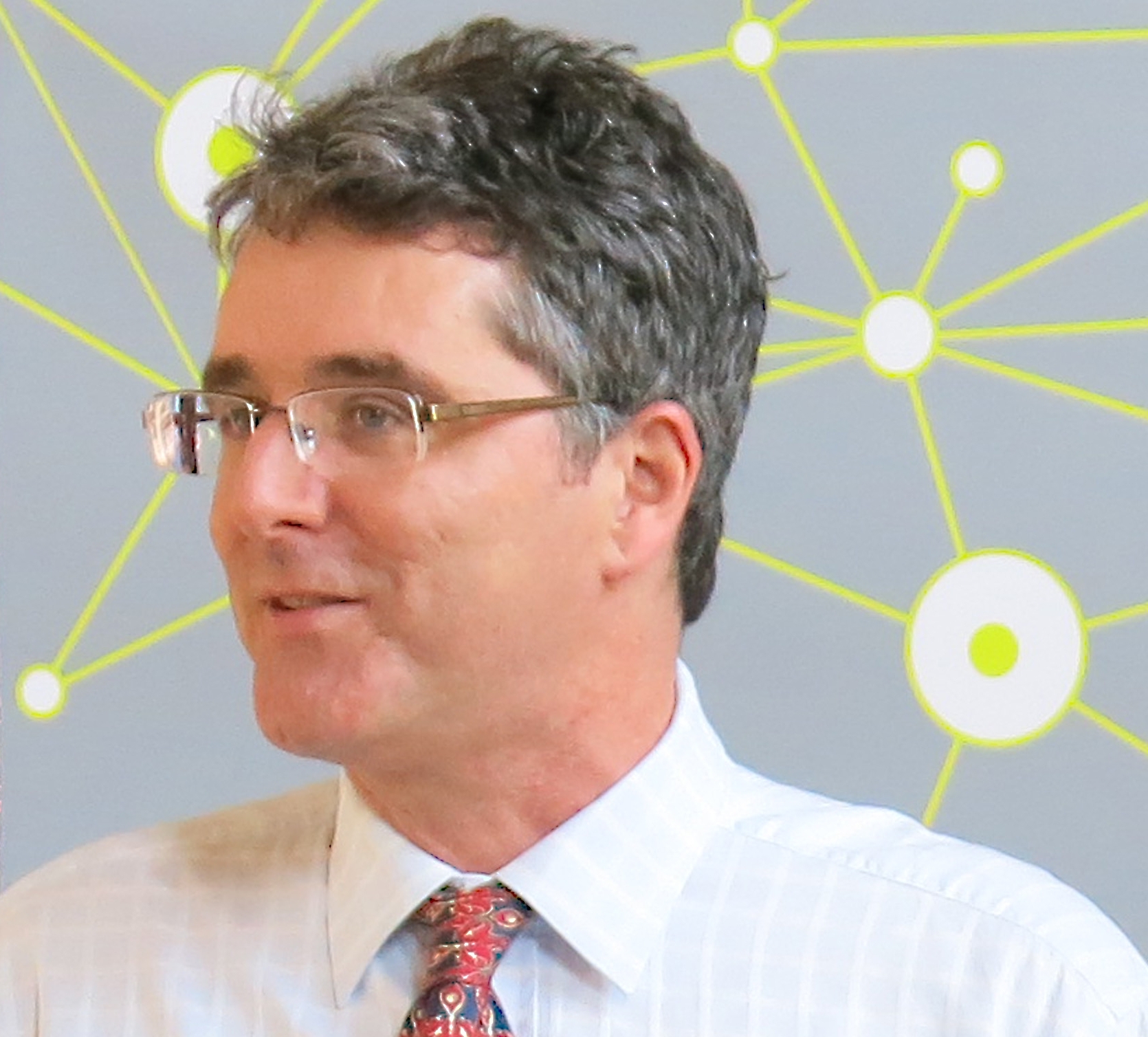
Robert Ackland is an Associate Professor with a joint appointment in the School of Sociology and the Centre for Social Research and Methods at the Australian National University. He has degrees in economics from the University of Melbourne, Yale University and the ANU, where he gained his PhD on index number theory in the context of cross-country comparisons of income and inequality in 2001, and he has worked as an economist at the Australian Department of Immigration and the World Bank. Since 2002 Robert has been conducting quantitative research into online social and organizational networks, and his research has appeared in journals such as the Review of Economics and Statistics, Social Networks, Computational Economics, Social Science Computer Review, and the Journal of Social Structure. He leads the Virtual Observatory for the Study of Online Networks Lab and he created the VOSON software for hyperlink network construction and analysis, which has been publicly available since 2006 and is used by researchers worldwide. Robert established the Social Science of the Internet specialization in the ANU’s Master of Social Research in 2008, and his book Web Social Science: Concepts, Data and Tools for Social Scientists in the Digital Age (SAGE) was published in 2013. Robert has been chief investigator on five Australian Research Council grants and in 2007, he was a UK National Centre for e-Social Science Visiting Fellow and James Martin Visiting Fellow based at the Oxford Internet Institute. In 2011, he was appointed to the Science Council of the Web Foundation’s Web Index project and he recently contributed a background paper to the World Bank’s World Development Report 2016: Digital Dividends.
SONIC Lab is proud to welcome Corinne Coen who will present a talk on Tuesday, March 29th, 2016 at 9:00 AM in Frances Searle Building, Room 1-483. All are welcome to attend. To schedule a one-on-one meeting with Dr. Coen please schedule a time HERE. Please contact Meghan McCarter with any questions or comments.
Associate Professor, Organizational Behavior, Weatherhead School of Management, Case Western University
The New Foundations: Emergence, Constructionism and the New Reductionism
Abstract
The science of studying emergence is not well understood among organizational scholars. Scholars often transfer assumptions from variance analysis to this particular application of process analysis. Further, its components parts—emerging, emergent outcomes and their properties—are often confounded leading to muddled thinking. In this paper, I distinguish among these components. Specifically, I discuss the features of complex systems drawing out distinctions between complex vs complicated non-linear systems, constituting vs causing, aggregation, levels, and holism. I draw out the implications of this research approach, emphasizing the paradigm shift required to apply it from other approaches, using examples from organization studies, particularly the Strategy Microfoundations debate.
Biography
Corinne Coen is an Associate Professor of Organizational Behavior at Weatherhead School of Management in Case Western Reserve University where she holds the Lewis Progressive Fellowship and is the Chair of the Faculty Council. She has an MBA from University of Chicago and a Ph.D. in Business Administration from the University of Michigan. Her research interests focus on the dynamics of work teams as they generate cooperation and competition, cohesion, and sub-groups. In the pursuit of understanding these dynamic processes, Corinne has special expertise in agent-based modeling and the study of cross-level emergence. Her work has been published in Organizational Science, Organizational Behavior and Human Decision Processes, Computational and Mathematical Organization Theory and Simulation Modeling Practice and Theory.
El acceso a grandes volúmenes de información sobre los fenómenos sociales en general y sobre la red en particular tiene un valor extraordinario para los científicos sociales. Pero esta apasionante oportunidad debe estar acompañada de la reflexión sobre cómo los big data pueden dar lugar a nuevas teorías y métodos. Utilizando ejemplos de su investigación en el área de redes, Contractor analizará el aporte de la Ciencia de Redes al desarrollo de nuevas comprensiones a partir de grandes volúmenes de datos. Más importante aún, ilustrará cómo estas ideas ofrecen a los científicos sociales y los estudiosos de redes sociales, una oportunidad sin precedentes para participar más activamente en la supervisión, la anticipación y el diseño de intervenciones para hacer frente a los grandes desafíos sociales. – See more at: http://citep.rec.uba.ar/blog/2016/04/20/2398/#sthash.b8XUhK7X.dpuf
La conferencia se realizará el miércoles 27 de abril a las 18 hs. en Pte. J. E. Uriburu 950, entrepiso.
No se requiere inscripción previa para participar de la actividad.
Scientists from Potsdam Institute for Climate Impact Research used network analysis to predict Indian monsoon timing more accurately and significantly earlier. The new predictions will help farmers in the region decide when to plant their crops. As co-author Jürgen Kurths explains, “On Facebook or Twitter, you can follow how news is spreading, one posting leading to many others. In the climate system, not people but geographical regions are communicating — admittedly in a quite complex way.” The key part of the analysis was identifying regions that illustrate important warning signals and analyzing their interaction with other regions.
SONIC JD/PhD candidate Ryan Whalen, along with coauthors Yun Huang (senior research associate at SONIC), Craig Tanis, Anup Sawant (senior software developer at SONIC), Brian Uzzi (SONIC affiliated faculty) and Noshir Contractor (SONIC lab director) recently published an article titled “Citation Distance: Measuring Changes in Scientific Search Strategies” in the Proceedings of the 25th International Conference Companion on World Wide Web.
Abstract:
Using latent semantic analysis on the full text of scientific articles, we measure the distance between 36 million citing/cited article pairs and chart changes in citation proximity over time. The analysis shows that the mean distance between citing and cited articles has steadily increased since 1990. This demonstrates that current scholars are more likely to cite distantly related research than their peers of 20 years ago who tended to cite more proximate work. These changes coincide with the introduction of new information technologies like the Internet, and the increasing popularity of interdisciplinary and multidisciplinary research. The “citation distance” measure shows promise in improving our understanding of the evolution of knowledge. It also offers a method to add nuance to scholarly impact measures by assessing the extent to which an article influences proximate or distant future work.
Lab Director Noshir Contractor, IEMS Professor Seyed Iravani, and SONIC PhD candidate Jackie Ng were recently awarded a unique grant from Northwestern University’s Office of the Provost and Faculty Distance Learning Workshop. Their project titled “Fostering Effective Online Discussion in Higher Education With ‘Nebula’, a Graphical Interface for Discussion Boards” was one of only nine projects to receive funding as part of an initiative to increase Northwestern’s visibility in digital and online teaching environments.
It’s the network study you’ve all been waiting for! Who is the most popular Game of Thrones character? Prof. Beveridge of Macalester College and one of his undergraduate students have calculated a number of network statistics based on the proximity of names mentioned in George R. R. Martin’s famous novels. The only question is: can these metrics help predict who is likely to meet an unfortunate end in the future? If popularity is a significant predictor then I’m not looking forward to what happens next!